

Is Pickleball Dying? Or Is the Hype Cycle Just Ending?
If you’ve spent any time on TikTok, you’ve probably seen the claim making the rounds: pickleball is past its peak. Facilities are closing. Loans are defaulting. The boom is over.
It’s a compelling take. It’s also missing context.
What we’re actually watching isn’t the death of pickleball. It’s the end of the frenzy phase and the beginning of something far more normal—and far more sustainable.
Where the “Pickleball Is Dying” Narrative Comes From
The argument stems from a business creator pointing to struggling indoor pickleball facilities as evidence that demand is shrinking. The logic goes like this: if facilities are failing, the sport must be fading.
That conclusion skips a few critical steps.
Private, indoor facilities are expensive to build and operate. Many opened quickly during peak demand years, took on significant debt, and priced their membership based on the assumption that growth would continue indefinitely. Some of those assumptions were wrong. That’s a real estate and business model issue—not a participation one.
A handful of failed facilities do not represent what’s happening across public courts, community centers, school programs, or recreational leagues. In fact, many facility operators that are succeeding have reported strong utilization through 2025 and are planning additional locations in 2026.
The Numbers Tell a Clearer Story Than the Headlines
Pickleball’s growth over the past five years has been extraordinary by any standard.
U.S. participation grew from 4—5 million players in 2020 to nearly 20 million by 2024, according to industry estimates. That’s a massive expansion in a very short window. Growth continued into 2025, just at a slower pace—which is exactly what market maturation looks like.
This is the part that often gets lost in viral takes: slower growth is not decline.
Every mainstream sport follows a similar pattern:
Rapid discovery
Mass adoption
Normalization
Pickleball is moving from the second phase into the third. Participation is still rising, but the days of triple-digit year-over-year growth are over. That was never going to last.
Courts are still full. Leagues are still running weekly. Parks departments are still converting tennis courts and adding pickleball lines because usage data supports it. A sport in decline doesn’t trigger ongoing public investment.
Why Facility Closures Are Being Misread
Facility closures make headlines because they’re visible and dramatic. Empty buildings feel like proof.
But most pickleball is not played inside privately owned indoor clubs. It’s played outdoors, on shared courts, in parks, at rec centers, and in spaces that existed long before pickleball arrived.
Some markets overbuilt. Some facilities overestimated how much players would pay for premium access. That correction was inevitable once the initial surge cooled. People haven’t stopped playing, but the industry is being forced to separate sustainable models from short-term bets.
Why Pickleball Isn’t Racquetball 2.0
Pickleball is often compared to racquetball as a cautionary tale. The comparison misses a key difference: accessibility.
Racquetball requires enclosed, purpose-built courts. Pickleball doesn’t. It fits into tennis courts, basketball courts, driveways, gyms, and parking lots. That flexibility is one of the biggest reasons it spread so quickly—and why it continues to thrive even when individual businesses struggle.
Pickleball also thrives on social play. Open sessions, mixed skill levels, and drop-in formats keep players coming back. That social structure matters more for long-term participation than media hype ever could.
What Gear Brands, Sponsorships, and Padel Actually Signal
Another reason people think pickleball is slowing down is what’s happening on the business side.
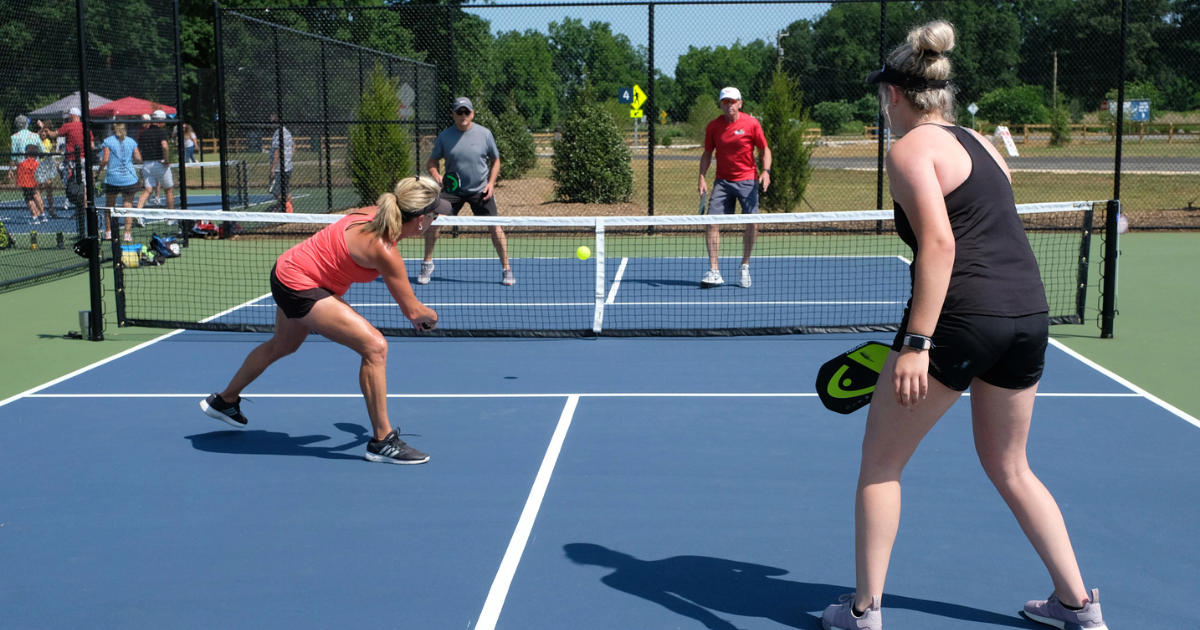
Photo by Mecklenburg County Parks & Rec
The gear market exploded. Hundreds of paddle brands entered the space almost overnight, many chasing the same players with similar products. That level of overcrowding was never sustainable.
Now we’re seeing consolidation. Some brands are disappearing. Others are diversifying into adjacent sports like padel. It’s a natural sign of a market maturing and demanding clearer differentiation.
The same applies to sponsorships and investment. Early money chased growth at all costs. The next phase prioritizes retention, audience quality, and real returns. That shift reflects a move toward discipline and long-term thinking.
Pro Pickleball Isn’t Collapsing Either
Professional pickleball is going through its own normalization.
Tour restructures, scheduling changes, media rights experiments, and franchise valuation adjustments are all part of a young sport figuring out how to operate at scale. The growing pains are visible, but they’re exactly what you’d expect at this stage.
The pro game may never look like the NFL—and it doesn’t need to. Recreational participation has always been pickleball’s foundation, and that foundation remains strong.
Maturity vs. Collapse: What Actually Matters
If pickleball were truly dying, we’d be seeing clear warning signs:
Sustained declines in participation
Widespread removal of public courts
Shrinking tournament registration across regions
Reduced municipal investment
Collapsing tournament attendance
That’s not what’s happening.
What we’re seeing instead is a sport settling into adulthood. Growth is steadier. The weakest business models are being filtered out. The ecosystem is becoming more realistic.
Where Pickleball Is Headed in 2026
Pickleball is entering a more stable, sustainable phase.
Going into 2026, the sport looks less like a gold rush and more like a category with staying power. Participation continues to grow. Community play remains accessible. Public infrastructure keeps expanding. Brands and facilities now have to build smarter and plan for longevity.
The hype cycle is cooling, but the foundation is solid.
Pickleball doesn’t need endless headlines to survive. It needs people to keep showing up. And by every meaningful measure, they still are.
Pickleball isn’t dying.
It’s growing up.
