

How College Pickleball Became a Home for So Many Women
On a Tuesday night in Austin, the rec center courts at the University of Texas are packed. Music leaks from someone’s Bluetooth speaker, homework can wait, and four courts are running king-of-the-court style. On three of them, it’s all guys in frat shirts and backwards caps.
On the fourth, calling scores in a clear, confident voice, is Zoeya Khan.

The Longhorn Pickleball Club winning at a PPA event
Khan is the president of the Longhorn Pickleball Club and one of the best collegiate players in the country. She grew up a top junior tennis player in Memphis and a high-school state champion before switching to pickleball, where she’s now a touring pro. At UT, she helped transform the club into a national powerhouse, leading the team to a DUPR Collegiate Pickleball National Championship title and earning First-Team All-American honors herself.
Nationally, pickleball participation is about 60% men and 40% women. On college campuses—especially in competitive clubs—that gender gap often gets wider.
And yet, quietly, steadily, women like Zoeya are building something different: a version of college pickleball where women aren’t just welcomed; they’re leading.
From “Just for Fun” to “This Is My Place”
When most people picture college sports, they think scholarships, stadiums, and strict practice schedules. Pickleball on campus looks nothing like that—at least not yet.
Most programs live in the in-between space: intramurals, club sports, and informal “show up and play” nights. As of 2025, USA Pickleball lists more than 160 colleges with active pickleball clubs, up from just a handful a few years ago.
That loose structure is exactly what’s drawing so many women in.
At Salisbury University in Maryland, for example, student Lindsay Kenna started a pickleball club because she loved the game and wanted somewhere for students to hang out, play, and feel welcome—no tryouts, no pressure. She describes the club as “just as much a social event as it is a sport” and says her leadership team spends as much time teaching beginners as they do playing.
At Utah Tech University, club leaders say 80–120 students show up for club nights, with around 600 unique students participating each semester—the largest club on campus.
Inside this growth curve, women are carving out space in three key ways: leadership, belonging, and life beyond the court.
Leadership: Women at the Center of the Court
College pickleball is still largely student-run. That means the people who volunteer to book courts, wrangle group chats, manage travel, and advocate with campus rec often shape who shows up—and who stays.
At Washington University in St. Louis, senior Ava Schumacher serves as co-president of the club. She helps coordinate open play and listened when members kept asking for more serious competition. That feedback helped inspire the club’s new competitive branch, giving higher-level players a place to push themselves without losing the relaxed culture that brought everyone in.
Then there’s Zoeya at UT Austin, whose role goes far beyond lineups and ladders. Under her leadership, the Longhorn Pickleball Club didn’t just win a national title; it became known for its chemistry and culture. National media have highlighted how she turned a student club into a competitive, inclusive powerhouse, balancing high standards with a welcoming environment for new players.
Zooming out, writers tracking NIL and collegiate pickleball note that women’s programs are increasingly led by women captains and presidents, often without the financial or institutional support that men’s programs receive. They’re doing scheduling, fundraising, recruiting, social media, and travel logistics—all while being full-time students.
In other words, the women on court are often the ones holding the entire ecosystem together.
Belonging: Being the Only Woman (Until You’re Not)
Ask women what it’s like to join a college pickleball club and they’ll often talk about the “first night feeling”:
You walk onto courts lined with guys already mid-rally. You worry that you’ll hold people back, or you’ll be judged as “taking it too seriously.”
That’s not just in their heads. Reports on women’s college pickleball point out that many campus programs skew male, especially in competitive divisions, and that women often find themselves outnumbered in leadership and court time.
But pickleball’s structure gives women tools to claim space. It’s doubles, which means you’re never alone. It’s small-court, which rewards touch, anticipation, and communication as much as raw power. And the learning curve is forgiving: you don’t need a decade of junior tennis to feel competent.
That low barrier to entry is one reason the sport is so attractive to women who never saw themselves as “athletes.” BeyondNIL’s analysis of women’s college pickleball emphasizes how accessible rules, minimal equipment, and community-oriented culture make it easier for women to step in and feel like they belong.
On campuses like Salisbury and Utah Tech, leaders intentionally pair beginners with more experienced players and emphasize a welcoming vibe over strict rankings. That shift—from “prove you deserve to be here” to “we’re glad you showed up”—is especially powerful for women who’ve been shut out of or burned by traditional sports environments.
Belonging shows up in small moments:
A captain insisting that women rotate into the “top” court, not just the social one.
A group chat lighting up because a new woman asks if anyone wants to drill serves before class.
A male partner who listens when his female partner calls middle balls and trusts her read instead of overruling her.
Those micro-choices send a macro message: this space is yours too.
Pickleball as a Lifeline: Mental Health, Faith, and Identity
College is a lot—classes, jobs, social pressures, big questions about the future. The women building college pickleball aren’t just chasing medals; they’re crafting a coping mechanism.
Campus wellness reports and higher-ed coverage consistently highlight pickleball’s impact on mental health: it’s physically active, but low-impact; structured, but playful; social, but not performative. Students talk about how pickleball helps them manage stress, build friendships, and feel less isolated.
For women especially, the court can become one of the few spaces on campus where they’re not being evaluated on appearance, GPA, or career trajectory—but on communication, grit, and the simple joy of chasing a yellow ball with friends.
Sometimes, the game intersects with deeper parts of identity.
A recent Washington Post piece followed college women players navigating conflicts between their faith and the sport’s tournament schedules. One top player, Rachel Garff, enrolled at a second university just so she could compete in Sunday collegiate events, while also signing a petition—backed by more than 1,600 athletes and fans—asking organizers to move finals off Sundays to respect religious observance.
That tension—between ambition, values, and belonging—isn’t unique to pickleball. But the fact that women are at the center of these conversations shows how deeply they’re invested in shaping what collegiate pickleball becomes.
Beyond Campus: A Pipeline, Not a Dead End
If you’re a woman in many college sports, you know the drill: your playing career often ends at graduation.
Pickleball is different.
Because the pro and semi-pro circuits are still young, today’s college women are stepping into a wide-open landscape. Articles following collegiate NIL deals and the “future of pickleball” highlight how college players are already signing sponsorships, coaching part-time, and serving as ambassadors for the sport.
Zoeya, for example, is already on the PPA Tour while still a student, coaching at Austin Pickle Ranch when she’s not in class or leading the Longhorns. Her path—from junior tennis to college club president to traveling pro—would barely exist in most women’s sports without a full NCAA infrastructure. In pickleball, she’s not the exception; she’s an early blueprint.
Similarly, media and NIL platforms are now specifically spotlighting women’s college pickleball as a driver of gender equality in sports, arguing that because the sport is so new, there’s an opportunity to build equity from the ground up rather than retrofitting it later.
That means the women leading campus clubs today aren’t just filling time between exams. They’re shaping policies, expectations, and norms that will ripple outward:
How mixed-gender doubles is treated—true partnership or “guys carry the pace”?
Whether women’s matches are given equal streaming and promotion.
How clubs recruit and mentor women from other under-represented backgrounds—first-gen students, women of color, LGBTQ+ players, international students.
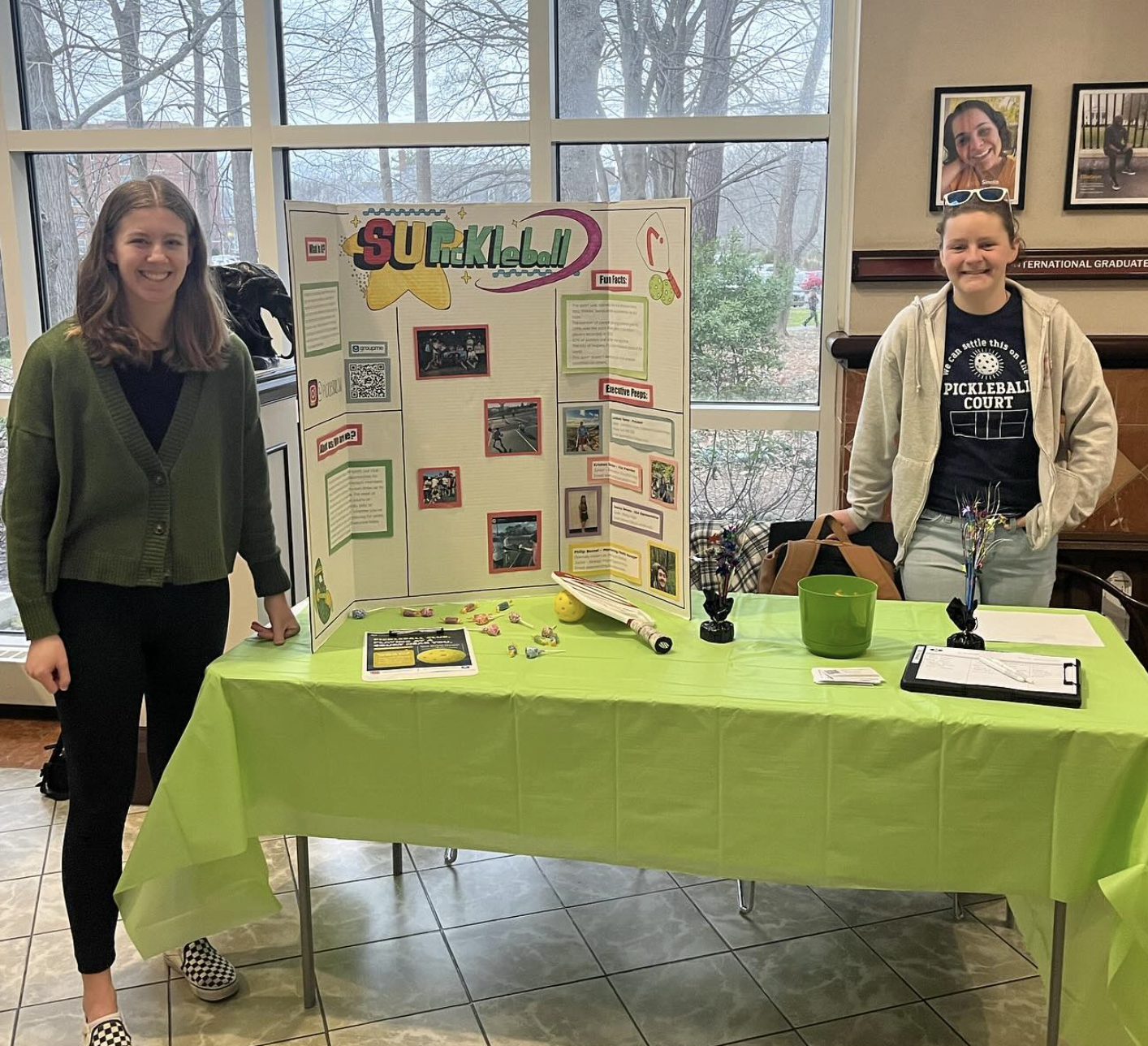
Members of the Salisbury University Pickleball Club at their campus involvement fair.
If college really is the pipeline to pickleball’s future, women are already standing in the flow.
Why It Matters That They’re Here
It can be tempting to look at pictures from collegiate nationals—rows of courts, matching jerseys, banners—and assume everything is already sorted.
But listen closely to the stories inside those images and a quieter truth emerges: many women in college pickleball are still rare. They are still the only woman in their ladder group, the only woman on the executive board, the only woman in the car to a tournament.
That rarity is exactly why their presence matters so much.
Because when a first-year student wanders past the rec center and sees someone like Zoeya running a drill, or Lindsay at Salisbury laughing with a circle of friends between games, or a woman captain calling lineups with authority, the story in her head shifts from “That looks like something the guys do” to “Maybe that could be mine too.”
College pickleball became a home for so many women not through big institutional campaigns, but through accumulated small acts of leadership and welcome:
A DM saying, “Come play, we’ll teach you.”
A club president who budgets for women’s brackets and travel, not just co-ed teams.
A coach who sees potential in a woman who picked up a paddle last month, not last decade.
The sport is still figuring itself out. There are no NCAA rulebooks yet, no decades-old power structures, and fewer “this is how it’s always been done” roadblocks. That blank space is the opportunity.
If college pickleball continues to grow the way the data suggests—more courts, more clubs, more tournaments—women won’t just fill in the roster spots. They’ll fill in the culture. And years from now, when students talk about how they got through college, they won’t just talk about majors and jobs.
They’ll talk about the nights under campus lights, the echo of a plastic ball, and the women who made the court feel like home.
