

Why Golf Brands Are Moving Into Pickleball (And What Callaway’s Paddle Signals)
Spend enough time around pickleball courts and the crossover becomes obvious. The players, the pace of play, even the way people talk about the game all feel familiar.
Golf and pickleball aren’t competing for attention. They’re pulling from the same kind of player. Someone who wants to be active without being all-consumed by it. Someone who enjoys the social side just as much as the competition. Someone willing to invest in equipment, but only if it actually makes the experience better.
The overlap didn’t need to be created. In a lot of cases, it’s happening in the same places. Courts are being built next to fairways, and the same players are moving between both.
Why Golf Brands Are Moving Into Pickleball Now
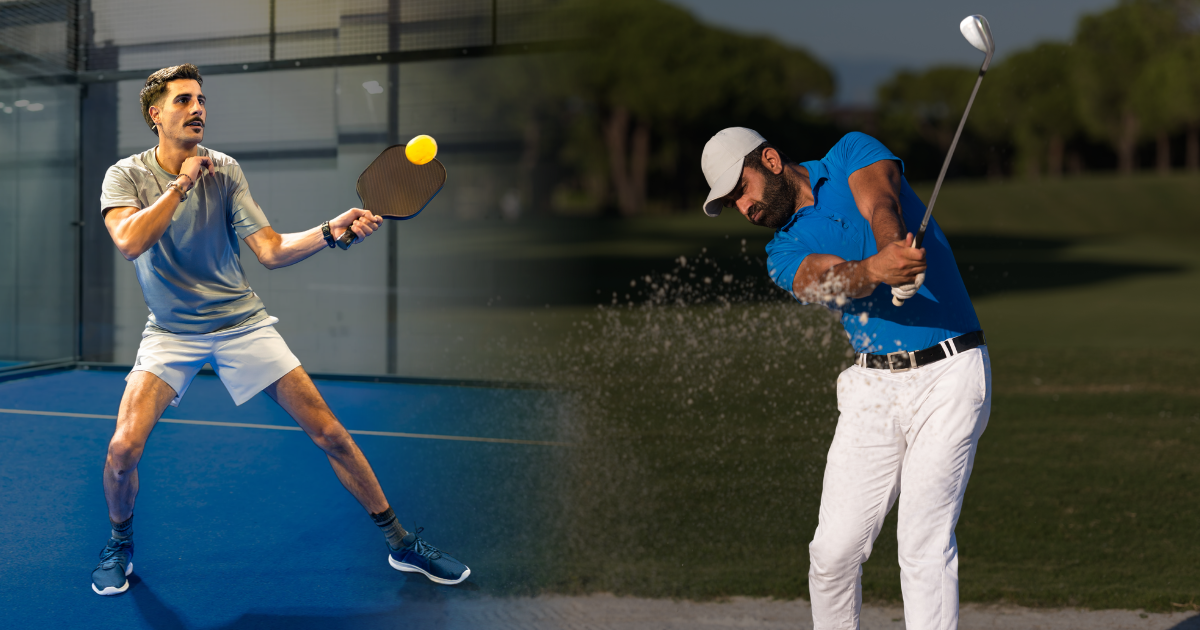
Pickleball has reached a point where participation and spending are large enough to demand attention, not just curiosity. Growth has been sustained, not spiky, and the equipment market is following the same trajectory.
For golf brands, the opportunity is straightforward. They already understand the customer, already operate in the same retail environments, and already build products for players who care about feel, consistency, and performance.
The difference is frequency. Golf is something people schedule. Pickleball is something they can play whenever they have an hour.
More play leads to more reps, which leads to more awareness of equipment—and eventually, more spending.
This isn’t a stretch into something unfamiliar. It’s an extension into something adjacent.
The First Golf Brands Are Already Entering Pickleball
Major golf brands are already stepping into pickleball.
PXG moved early, launching the XP1 and XP2 paddles with clear performance positioning rather than easing in with entry-level gear. Mizuno followed, appearing on the USA Pickleball approved list with its own paddle line and pickleball-specific shoes.
At the same time, other golf-adjacent brands have tested the space with basic sets and merchandise—products that feel more like branding exercises than serious equipment.
That split is important. Some brands are experimenting. Others are trying to compete.
Callaway’s recent launch clearly puts it in the second group.
The Callaway Inertia Pickleball Paddle enters at the top of the market. At $249.99, it lands directly in the premium tier, alongside the most established brands in the sport.
The build reflects that positioning: a 16mm polypropylene honeycomb core, a unidirectional T700 carbon fiber face supported by a fiberglass stabilizing layer, and a hybrid shape designed for balance reach and forgiveness. On paper, it belongs in the same conversation as the paddles from JOOLA, Selkirk, and CRBN.
But what makes it stand out isn’t the materials. Those have largely standardized across the category. It’s the approach behind them.
How Golf Design Is Influencing Pickleball Paddles
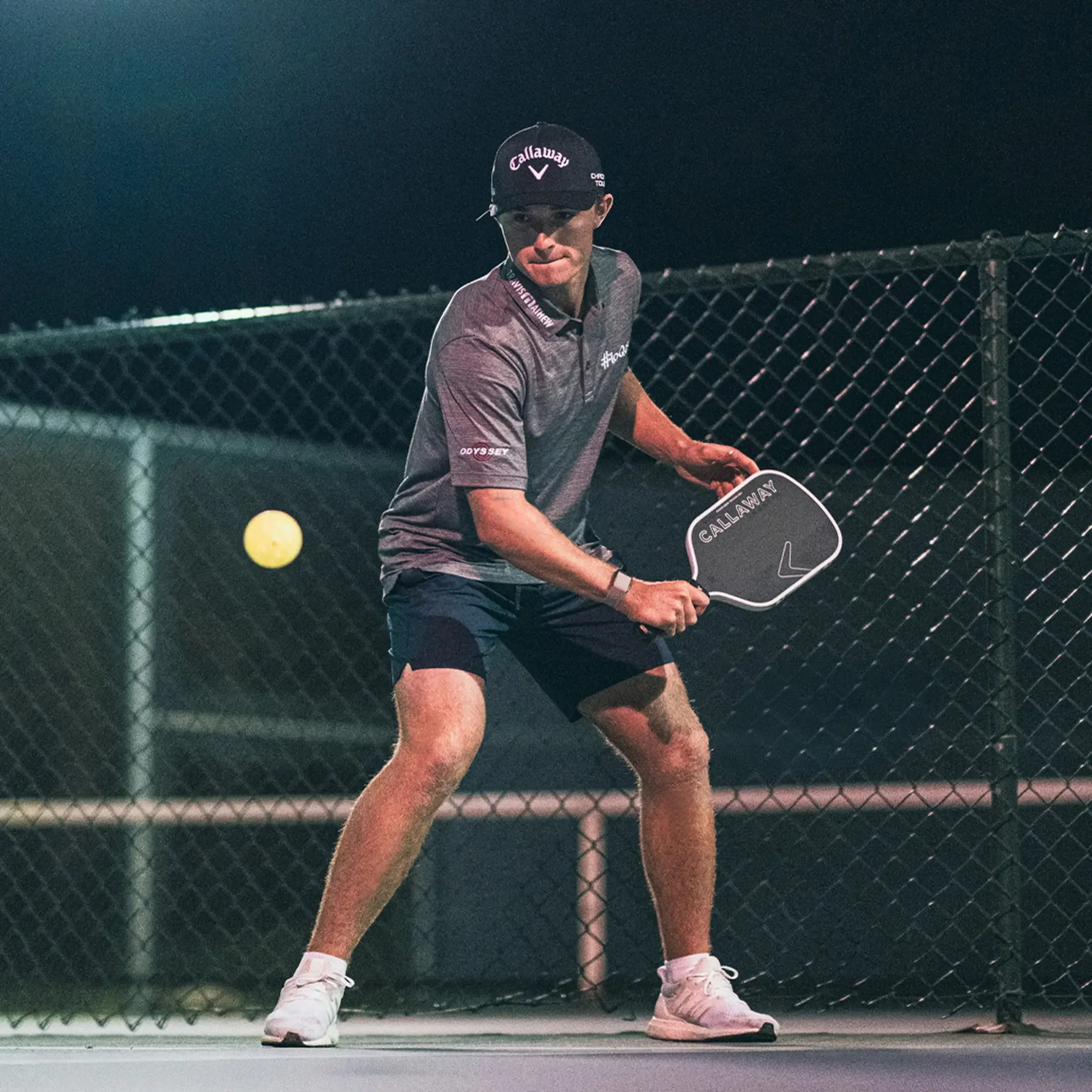
On-court with the Callaway Inertia Pickleball Paddle, designed to reduce twist and improve consistency on off-center contact.
Callaway didn’t try to win on power. Instead, it leaned into something that’s been core to golf equipment design for decades: forgiveness.
The paddle is built around perimeter weighting—marketed as Power Edge Technology—with the goal of increasing stability and reducing twisting on off-center contact.
If you’re not deep into paddle specs, the difference shows up in how it feels on court:
More stability in fast exchanges
Less punishment on mishits
More predictable contact from shot to shot
It’s a subtle shift in focus, but a deliberate one.
You don’t lose most points because you lack power. You lose them on mishits, especially under pressure—and this is built to reduce them.
It’s the same way golf brands approach performance.
What This Means for the Pickleball Industry
Golf brands are entering at the highest level of the market, where expectations are already defined and competition is tight. That alone raises the standard for what new entrants need to deliver.
At the same time, brand recognition still plays a role. A name like Callaway carries weight, especially for players who don’t want to overanalyze every spec before making a purchase. Trust shortens the decision-making process, even in a performance-driven category.
The broader shift is harder to ignore. Pickleball is no longer operating in its own lane. It’s becoming part of a larger ecosystem of sports and lifestyle brands that see it as a natural extension of their audience. You’re seeing it beyond golf, too, with brands like Nike entering the space.
These brands didn’t need to enter early. They waited until the category proved it was worth taking seriously.
And they didn’t ease in. They went straight to the top of the market—and the pro scene—and built products that, at least on paper, belong.
