

Should You Hire a Pro? The Real Pros and Cons of Private Pickleball Lessons
Every pickleball player reaches a point where improvement slows—and frustration starts to creep in.
You walk off the court disappointed, not because you played badly, but because nothing has changed. Your serve still floats. Your third shot drop is hit or miss. And the same opponents keep targeting you game after game.
Sooner or later, most players start wondering: “Is it time for a lesson, or do I just need to play more?”
It’s a question that pops up in pickleball communities week after week, usually in some version of: “I play 3–4 times a week and I’m stuck. Would a $100 lesson actually help?”
Private pickleball lessons have exploded alongside the sport. In many areas, an hour with a certified instructor now costs close to $100. That can feel like a serious investment for what started as a casual recreational activity. The real question isn’t whether lessons help—they do—but whether they are the right solution for your stage of development.
What a Private Pickleball Lesson Actually Does
The real value of a private lesson isn’t the drills. It’s the diagnosis.
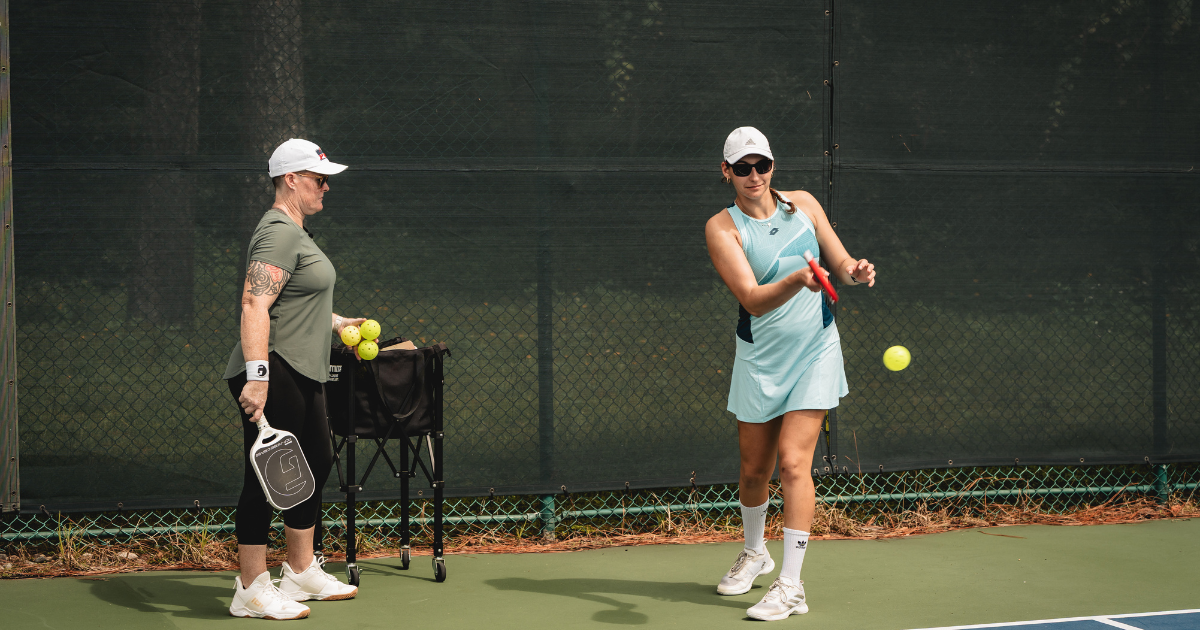
Photo by A Stewart Photo & Video
Most recreational players don’t struggle because they lack effort. They struggle because they’re unknowingly reinforcing the wrong habits. A player might assume they have slow reactions or poor hands when the real issue is something as simple as paddle position. Another may blame their partner, when the actual problem is court positioning or footwork timing.
One experienced player put it perfectly:
“I thought I had slow hands. Coach moved my paddle six inches higher and suddenly I could volley.”
Grip pressure, paddle angle, and movement before contact are nearly impossible to self-correct because you cannot watch yourself play in real time. A coach can identify within five minutes what a player might otherwise reinforce incorrectly for months.
The Time Factor
Private pickleball lessons don’t just improve mechanics—they shorten the learning curve.
Pickleball is deceptively easy to start. Because beginners can rally quickly, many players advance to intermediate play while still carrying flawed fundamentals. By the time competition ramps up, those habits are deeply ingrained. Fixing them later requires unlearning old habits before relearning the right ones.
Players often realize this after the fact: “I wish I had taken a lesson earlier. I spent a year practicing the wrong drop shot.”
A short instructional session early in a plateau often prevents months of frustration. In that sense, lessons are less about buying skills and more about avoiding wasted time. When you look at pickleball lesson costs over a full year, one well-timed session can be far more efficient than months of unfocused play.
The Downsides No One Mentions
However, lessons are not a guaranteed improvement.
The most common problem is information overload. Players often leave a lesson with multiple grip changes, footwork adjustments, and strategy concepts. When they return to open play, instincts take over and everything they just learned disappears.
As one player put it: “The coach gave me five things to fix and I forgot all of them as soon as the game started.”
The second issue is cost efficiency. Recreational players typically play games, but don’t tend to drill as much. If you never practice intentionally between lessons, weekly instruction becomes expensive repetition.
Another player summarized it bluntly: “Lessons help, but only if you’re willing to drill. Otherwise you’re just paying for a pep talk.”
Private coaching works only when paired with practice. The lesson shows you what to do. But the improvement comes from doing it a hundred times afterward.
Why Clinics Might Actually Be Better Early On
Many players assume private lessons are the best starting point. In reality, group clinics often provide more value early on.
Clinics teach positioning, communication, and decision-making—the real structure of doubles pickleball. They also expose you to players at your level and provide structured drills that you’re unlikely to organize on your own.
A common beginner realization: “I didn’t need a better forehand. I needed to stop standing in no-man’s land.”
Private pickleball lessons fix mechanics.
Clinics teach how the game actually works.
For newer or early-intermediate players, understanding movement and shot selection often matters more than perfect technique.
Who Should Take a Private Lesson?
Private pickleball lessons make the most sense for players who have clearly plateaued. If you’ve been playing consistently for several months and see no change in results, you are likely reinforcing a mechanical or positioning issue you cannot identify yourself.
You should strongly consider a lesson if:
Stronger players consistently target you
Your drops and dinks remain unreliable
You feel stuck despite playing frequently
For brand-new players, the biggest gains usually come from just playing. Things like court awareness, scoring comfort, and confidence develop naturally through repetition.
A question we hear all the time from beginners: “I just started last month—should I get a coach?”
Usually, the answer is no. At that stage, time on the court is far more valuable than any lesson.
How to Choose a Coach
Here’s the part many players don’t realize:
A good lesson can change your game.
A bad lesson can actually set you back.
Pickleball’s growth created a strange situation—there are now thousands of instructors, but not all of them are trained teachers. Being a strong player and being a good coach are completely different skills. Some great players struggle to explain concepts, while some mid-level players are excellent instructors.
Before you book a session, it’s worth doing a little homework.
First, look for someone who has actual coaching training. Certifications like PPR (Professional Pickleball Registry) or another recognized coaching program don’t guarantee a perfect lesson, but they do indicate that the instructor has learned how to teach fundamentals progressively and safely.
Second, watch them teach if possible. Go to a clinic or open play where they’re working with others. Pay attention to how they communicate. Are they giving clear, simple corrections, or overwhelming players with too many changes at once?
Finally, ask other players—especially ones around your level—if they improved after working with that instructor. The best coaches consistently produce more confident players, not just players who say they had a fun hour.
A private pickleball lesson is an investment.
The coach you choose matters as much as the lesson itself.
The Most Effective Approach
The ideal improvement path is not weekly coaching. It is targeted coaching.
Play regularly. Take a lesson when progress stalls. Practice intentionally afterward. Join a clinic to apply strategy. Then reassess months later.
Many players only need occasional instruction, not continuous instruction. A single well-timed lesson followed by drilling can improve your game more than ten passive sessions.
Are Private Pickleball Lessons Worth the Cost?
So is a $100 pickleball lesson worth it?
Yes—but only when you know why you’re taking it.
A lesson is not a shortcut to becoming a better player. It is a tool to reveal what you are doing wrong. The improvement comes afterward, in the repetition you commit to once you understand the problem.
Sometimes you need a coach.
Sometimes you need a clinic.
And sometimes you just need a friend willing to spend 30 minutes drilling instead of playing games.
Knowing which one you need is what actually makes you better.
