

5 Advanced Pickleball Strategies to Improve Your Game Fast
At some point in every pickleball player’s development, the basics stop being enough.
You already know to get to the kitchen line. You know you should dink instead of blasting every ball. You know consistency wins points. But the players who keep improving aren’t just hitting better shots—they’re using better strategies.
Advanced players think about how to create advantages during a rally, not just how to survive it.
If you want to level up quickly, these five advanced pickleball strategies will help you start controlling points instead of reacting to them.
1. Build Points Instead of Trying to Win Them
One of the biggest differences between intermediate and advanced players is patience with a purpose.
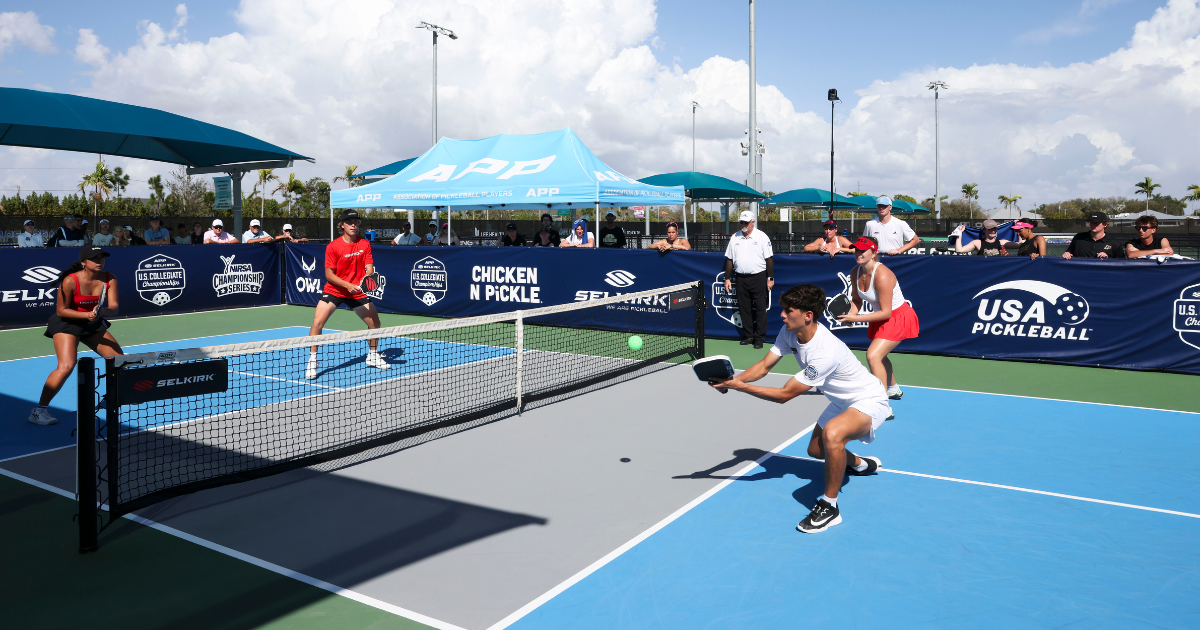
Photo via The APP
Intermediate players often look for the first opportunity to speed up the ball. Advanced players are comfortable building the rally first.
That usually means using dinks to move opponents out of position. A few well-placed crosscourt dinks can stretch a player wide, forcing them to reach or lean. Once they’re off balance, the attack becomes much safer.
Think of the dink rally as setting the trap, not just keeping the ball in play.
When the opening appears, you strike.
2. Make Your Opponents Hit the Hard Shot
A simple but powerful strategy is forcing your opponent to beat you with low-percentage shots.
Instead of aiming for lines or hitting risky winners, advanced players often target spots that make the next shot difficult.
Examples include:
Hitting deep returns that keep opponents back
Dropping the third shot low at the kitchen
Aiming dinks at an opponent’s backhand
When your opponent has to hit up on the ball or reach outside their comfort zone, mistakes happen naturally.
The goal isn’t always to hit a winner—it’s to make the next shot harder for them than it is for you.
3. Attack the Player, Not the Space
Many players focus on hitting open areas of the court. That works sometimes, but advanced players often take a different approach.
They attack the opponent’s body.
Shots directed at the paddle-side hip, shoulders, or opposite foot are surprisingly difficult to handle. They jam players and usually result in a pop-up or a ball into the net.
Body shots are especially effective during kitchen exchanges because opponents have very little time to adjust.
Instead of trying to thread the needle past someone, try making them uncomfortable.
You’ll see plenty of weak blocks and pop-ups.
4. Use the Middle to Create Confusion
The middle of the court is one of the most underused weapons in pickleball strategy.
When a ball travels between partners, even experienced teams can hesitate for a split second, deciding whose shot it is. That moment of indecision often leads to weaker contact.
But there’s another advantage: hitting the middle reduces the angles your opponents can create on the next shot. Drop the ball softly to the middle of the court and tempt your opponent to make a rushed decision.
That means fewer sharp crosscourt counters and easier balls for your team to handle.
When in doubt—especially during fast exchanges—the middle is often the smartest target.
5. Make the Court Feel Small
As the level of play increases, the margin for error shrinks. One of the rites of passage in pickleball is watching a shot that used to be a winner against your regular group get smashed right back at you by a more experienced opponent.
Advanced players make the court feel small by anticipating what’s coming next.
That means leaning into the kitchen when you recognize a drop or dink coming. It means flying over the kitchen to Erne any ball that crosses the net near the sideline. And it means punishing those audacious lob attempts with a decisive overhead.
When you consistently apply pressure like this, you force your opponent’s shots to be perfect—and that’s when the unforced errors start to pile up.
Strategy Is the Fastest Way to Improve
Improvement in pickleball doesn’t always come from hitting more balls.
Sometimes it comes from thinking about the game differently.
When you start building points, targeting weaknesses, and controlling the pace of play, rallies become easier to manage—and winning points become far more consistent.
Master these five advanced pickleball strategies, and you’ll start noticing something quickly:
Your opponents will be the ones scrambling, not you.
