

A Second Mega Facility in China? What Ramsports’ New Shenzhen Expansion Means for Global Pickleball
If you want to understand where pickleball is going, you need to stop looking only at the United States.
Some of the most ambitious development in the sport right now isn’t happening in Florida, Texas, or Arizona—it’s happening in Shenzhen, China.
And one of the companies leading that push is Ramsports.
Most players have at least heard of Ramsports’ first facility because it made headlines across international pickleball media. What hasn’t been talked about as much is that the original venue was only phase one.
A second, significantly larger project now appears to be moving from concept to reality.
The First Facility: Mission Hills “Flagship” Stadium
Ramsports’ original Shenzhen complex opened in January 2025 in the Mission Hills / MH Mall area of Longhua District with a high-profile launch ceremony.
The facility immediately stood out because it wasn’t just another set of courts—it was built like a true sports venue.
The complex includes:
10 international-standard pickleball courts
A mix of indoor, outdoor, and retractable-roof courts
Approximately 3,500 square meters of space
IPTPA-accredited coaching and programming
The retractable roof design is especially notable. It allows play during rain and extreme heat, which is critical in southern China’s climate and shows long-term planning for year-round participation and events.
From the beginning, the Mission Hills venue was positioned not only as a place to play, but also as a location capable of hosting tournaments, training, and international visitors.
It now looks like that project was never intended to be the final step.
The New Longgang Facility
Public interviews and development signals suggest Ramsports has been working on a second location in the Longgang District—and it’s considerably larger.
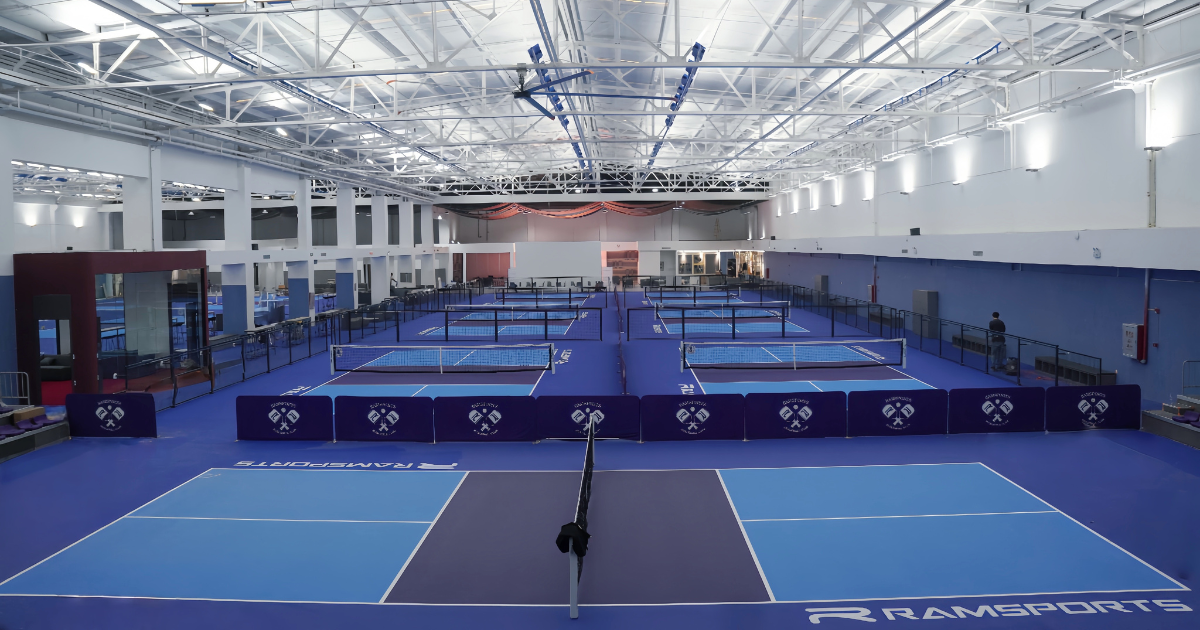
The new Ramsports pickleball facility in Longgang, China.
In a March 2025 local government profile interview, Ramsports leadership described the Longgang concept as “much bigger” than the original Mission Hills facility. The plan discussed includes:
Around 20 climate-controlled indoor courts under one roof
A dedicated stadium court
Fully indoor competition conditions
That scale would put the venue closer to a national training center than a local club.
Additionally, Ramsports’ social media activity has referenced a “soft opening” of Ramsports Longgang, noting that courts are already operational. While detailed specifications and the exact address have not yet been widely published, the messaging strongly suggests the project has moved beyond planning and into an early launch phase.
What We Know vs. What’s Still Emerging
Confirmed
The Mission Hills facility’s specifications and role as a major international venue are well documented. Ramsports has also publicly discussed its intent to build a significantly larger Longgang complex.
Still Developing
Full build-out details, including final court count, amenities, and tournament capacity, have not yet been officially released in a comprehensive public announcement.
Still, the direction is clear.
Why This Matters (Even to a Rec Player)
It’s easy to think international facilities don’t affect your local courts.
They do.
For pickleball to become a true global sport—and eventually an Olympic sport—it needs infrastructure outside North America. Not just players, but professional-level venues capable of hosting training programs, national teams, and international competition.
That’s exactly what projects like this represent.
Facilities like Longgang could allow:
National training academies
International tournaments
Youth development programs
Cross-country team events
Right now, most of the world’s top players live in the U.S. Long-term growth requires the sport to be playable and competitive elsewhere.
China’s investment in large-scale, permanent pickleball venues is a sign that the sport is no longer a niche export. It’s becoming a global sport with real infrastructure behind it.
The Bigger Picture
For years, pickleball growth was measured by new courts in parks and recreation centers.
Now we’re seeing something different:
purpose-built stadiums, professional coaching pipelines, and international development strategies.
That’s the shift from a recreational boom to a sport with a global ecosystem.
You might never play in Shenzhen. But the existence of facilities like this increases the chances that one day you’ll watch a true international championship, or a country-vs-country event, and understand exactly how the sport got there.
Pickleball started as a backyard game.
Projects like this are what eventually turn it into a worldwide one.
