

The Shrinking Court: Why Cross-Court Makes More Sense
When you first step onto a pickleball court, it looks simple: a clean rectangle, 20 feet wide and 44 feet long. But understanding how that rectangle plays—and how it changes during a rally—is the key to smarter shot selection. If you want to win more points and cut down on unforced errors, you should be hitting cross-court far more often than down-the-line.
Let’s start with geometry.
At the beginning of a point, the court is at its maximum length: 44 feet from baseline to baseline. That long rectangle tempts players to aim straight ahead. Down-the-line shots feel direct and aggressive, but they’re also risky. You’re working with a narrow lane—just the 10-foot width of your half of the court—and the full 44-foot length. That’s not much margin for error.
Now think about what happens as the rally develops.
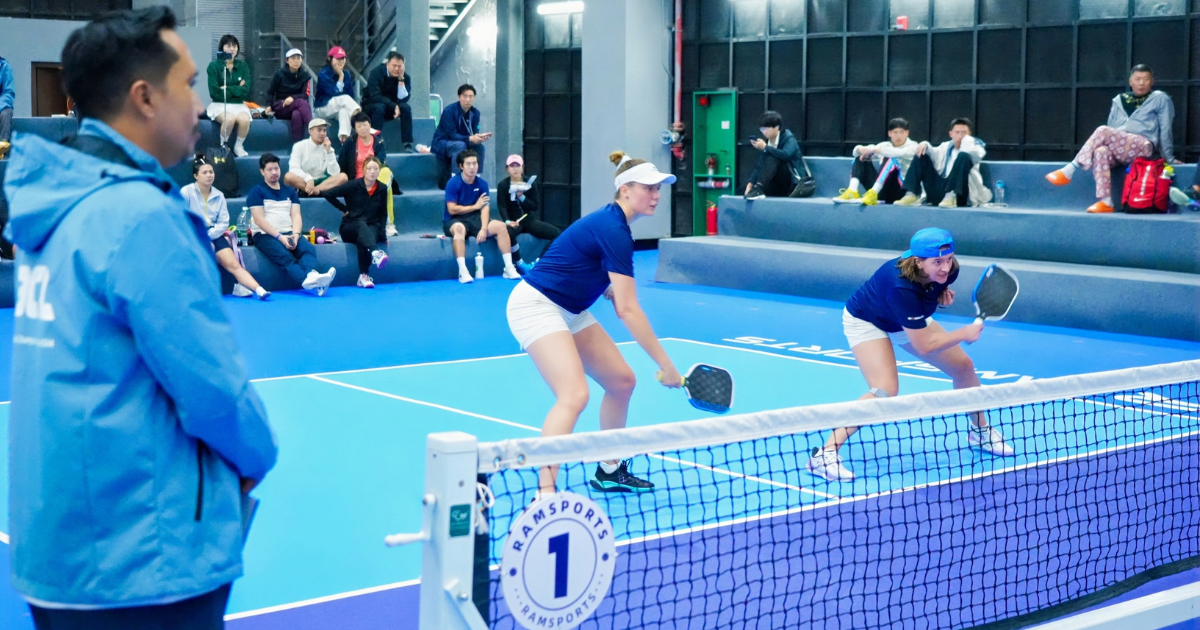
In good pickleball, all four players work their way to the kitchen line. Once everyone is established there, the “playable” court effectively shrinks. You’re no longer hitting into 44 feet of depth. You’re hitting into roughly 14 feet—the distance from one kitchen line to the other. The length of the court has compressed dramatically.
But the width? It’s still 20 feet.
So when all four players are at the kitchen, you’re playing inside a short, wide rectangle. That’s where cross-court strategy really shines.
When you hit cross-court, you’re using the full diagonal of that rectangle. A diagonal is always longer than a straight line across. That extra distance gives you a greater margin for error. You can aim safely over the middle of the net and let the natural geometry of the court work for you. Even if your shot isn’t perfect, it has more space to land in.
Compare that to a down-the-line dink or drive at the kitchen line. You’re now hitting into the shortest possible distance—about 14 feet straight ahead—with no extra width to help you. The sideline is right there. Miss by a few inches, and the ball is out. There’s simply less room for error.
And here’s another advantage: the net.
The net is 36 inches high at the sidelines and 34 inches high in the center. That two-inch difference might not sound like much, but in a soft game of inches, it matters. Cross-court shots naturally travel over the lower middle section of the net. Down-the-line shots often pass closer to the higher sideline portion. When rallies are tight and contact points are low, those two inches can be the difference between continuing the point and handing it away.
Cross-court shots also buy you time. Because the ball travels farther on a diagonal, your opponent feels slightly less rushed and isn’t as likely to attack aggressively. Meanwhile, down-the-line balls arrive faster and can be redirected sharply by a prepared opponent—especially the player straight across from you.
In a shrinking court, safety and geometry matter. The length shortens, the width remains, and the diagonal becomes your friend.
So the next time you’re at the kitchen line, picture that 20-foot-wide, 14-foot-long rectangle. Use the space. Aim diagonally. Clear the lower part of the net. Give yourself the larger margin.
In pickleball, smart players don’t just hit the ball. They play the rectangle.
