

Why Your Backhand Is the Key to Better Pickleball Defense
If your defense breaks down under pressure, it’s usually not your feet. It’s your paddle face. And often, the backhand is the fix.
The modern game has changed. Players are hitting harder, faster, and with more precision. You don’t have time for big swings or perfect setups. You need something compact, stable, and repeatable. That’s exactly what the backhand gives you.
The backhand is naturally more stable because of how the body supports it. When you’re in a neutral position at the kitchen line, your paddle is already centered. From there, the backhand requires less movement to meet the ball. There’s no big take back and no extra rotation—just a short, controlled motion. That simplicity is what holds up under speed.
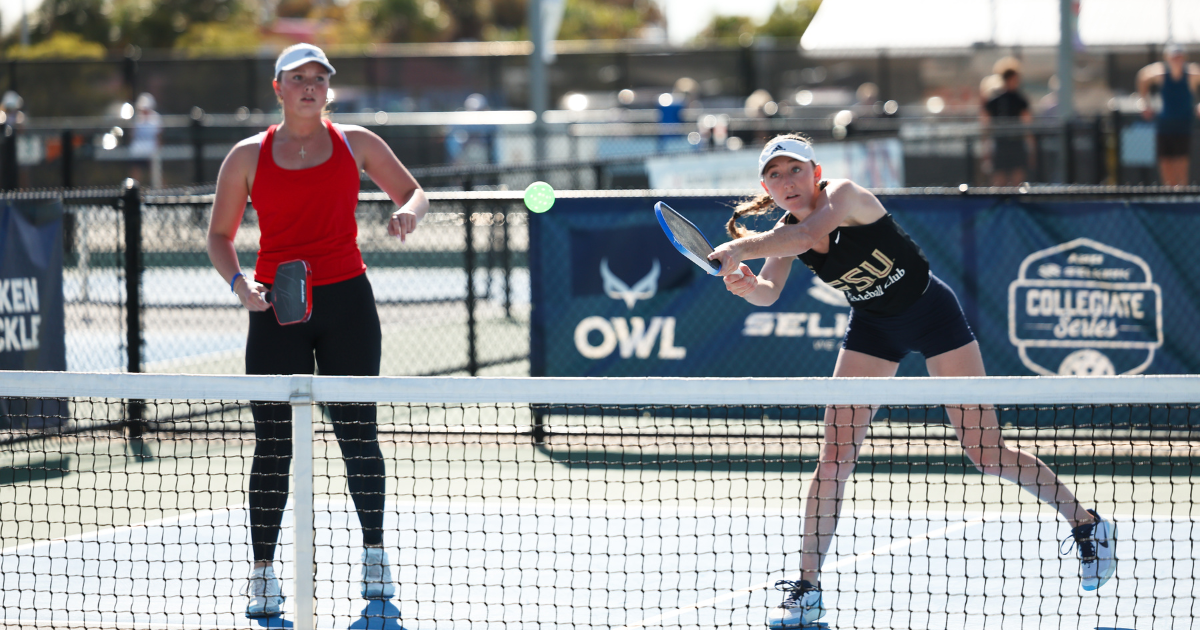
Photo by The APP
Mechanically, the backhand puts your paddle in front of your body with structure behind it. Your shoulder, arm, and core stay connected, forming a solid unit. When you block or reset, you’re not swinging. Instead, you’re absorbing and redirecting. The paddle face stays quiet, the wrist stays firm, and the ball comes off soft. That’s exactly what you want when someone is speeding it up at you.
On the forehand side, things get riskier under pressure. The instinct is to take a bigger swing or open up too early. The arm can separate from the body, and the paddle face becomes harder to control. That’s when balls pop up or sail long. The forehand has more power potential, but it also has more moving parts. Under fire, more moving parts often means more errors.
The backhand eliminates that chaos. It keeps everything in front. It shortens your reaction time. And it allows you to defend without overcommitting.
This is especially important in hand battles and fast exchanges. The best defenders don’t try to win those moments offensively. They neutralize. A strong backhand lets you take pace off the ball, drop it into the kitchen, and reset the point. It turns defense into a second chance instead of a losing battle.
At higher levels, players are no longer targeting the backhand as a weakness. They’re respecting it as a strength. Some players are even leaning into their backhand in defensive situations because it gives them more control when the game speeds up.
Practicing different backhand shot variations is key when drilling. You want to get to the point where it becomes your go-to shot.
About the Author: Gina Cilento is a top 10 Senior Pro and multi-APP medalist who splits her time between competing and coaching. She’s the co-founder of The Pickleball Lab, a pod player for the Denver Iconics in the Champions Series Pickleball League, and co-host of Keeping It Real with Gina & Neil. Off the court, Gina shares her passion through her apparel line, The Pick, and her work with Empower Pickleball.
