

How to Break Bad Pickleball Habits—and Avoid Forming New Ones
You start out just trying to keep the ball in play. Then you start winning a few points. Then suddenly, six months later, you realize your serve looks like a shove, your dink technique changes every three shots, and your backhand has become a cry for help. You don’t even recognize your own shots anymore.
Congratulations. You’ve developed bad habits.
Most bad pickleball habits work just well enough to survive. And that’s exactly why they’re so hard to get rid of.
Let’s talk about how to unlearn poor form, correct bad tendencies, and rewire your game the right way—without swapping one problem for another. And yes, we’ll also talk about why a good coach can save you months (or years) of frustration.
Why Bad Habits Stick Like Glue
Bad habits don’t come from laziness. They come from:
Trying to compensate for lack of technique
Copying the wrong player (usually the loud one who hits hard)
Winning points despite poor mechanics
Practicing without feedback
Never being corrected by someone who actually knows better
If something works once, your brain assumes it’s brilliant. It doesn’t care if your shoulder dipped too low, your feet were halfway out the door, or you lunged and overcompensated because you thought you were fast enough—until you realized you weren't.
That’s why yelling “just stop doing that” at yourself rarely works. And yet… we still do it. (At least I do.)
The Biggest Mistake: Replacing One Bad Habit with Another
Many players recognize something is wrong and immediately try to “fix” it. Unfortunately, that often looks like:
Overcorrecting swing paths
Forcing unnatural grips
Freezing body movement instead of refining it
Thinking about too many cues at once (hello, brain overload)
Example:
You realize you’re wristy on your dinks… so you lock your wrist entirely… and now your dinks float high and land short. You didn’t fix the problem—you traded it for a worse one.
Step One: Identify the Root Problem (Not the Symptom)
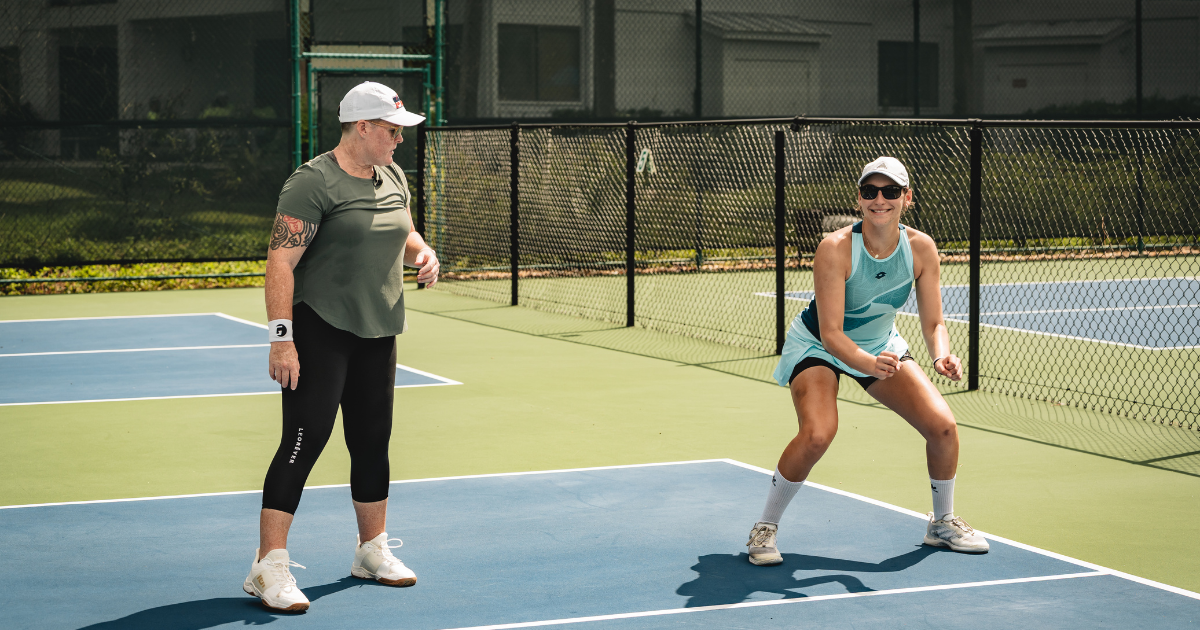
A photo of Director of Pickleball at PPR Sarah Ansboury teaching a player correct form.
Photo by A Stewart Photo & Video
This is where a good coach becomes invaluable. And yes, the good ones won’t be “yes” coaches. They’ll be honest and concise.
A trained coach doesn’t just say:
“Your backhand looks odd.”
They say:
“Your footwork is late, which is forcing your arm to compensate and limiting your shoulder turn.”
That distinction matters.
Without proper identification, players often:
Fix timing issues by muscling the ball
Fix consistency by slowing swings incorrectly
Fix power issues by breaking mechanics entirely (sometimes it looks like a full-body spasm)
A coach sees cause and effect, not just the end result.
What a Good Coach Actually Does
A high-quality pickleball coach will:
Spot improper mechanics before they become permanent
Explain why something feels awkward (so you don’t abandon it too soon)
Give one or two focused adjustments, not ten (Remember, brain overload will diminish everything if it is too much at one time)
Prevent overcompensation before it becomes a new habit
Most importantly, a good coach helps you change habits intentionally instead of randomly experimenting and hoping something sticks.
Practical Strategies to Break Bad Habits (Without Losing Your Mind)
1. Slow Down—On Purpose
If you’re trying to change form at full speed, you’re basically asking your nervous system to panic.
Practice at 50–70% speed
Isolate the skill (don’t “play through it”)
Accept that performance temporarily drops
If it doesn’t feel uncomfortable, you’re probably not changing anything.
I see this all of the time. Most players care more about winning the rec game than fixing mechanics they know need work. My advice? Stop being selfish. Forget the win. Aim to change habits that support consistency for many, many years to come. You know, the marathon-sprint analogy!
2. Use Constraints
Instead of thinking “don’t do X,” set rules that make X impossible.
Examples:
Only hit crosscourt dinks during a drill
Start points at the kitchen line
Serve aiming at one specific target
Constraints force better mechanics without mental overload.
3. One Change at a Time. Seriously.
Trying to fix:
Grip
Footwork
Swing pattern
Contact point
All at once is how pickleball players end up confused, annoyed, and distrusting themselves.
Pick one priority. Drill it. When you feel you have achieved it, move to the next. A coach helps you choose the right order—because the order matters.
4. Ball Don’t Lie (and Neither Does the Video)
Watching yourself play is humbling. Necessary. And mildly traumatic. I don’t love it either, but it’s extremely important.
Video helps you:
See habits you didn’t know existed
Confirm whether a change is actually happening
Avoid gaslighting yourself into thinking you “fixed it”
It also shows movement and positioning issues you may never feel in real time.
A coach can help interpret what you’re seeing so you don’t misdiagnose the issue… you know, those YouTube videos you obsessively watch and now move on to the next new, professional shot you believe you can master in one rec game.
How to Avoid Creating New Bad Habits While Fixing Old Ones
The Don’t List
Don’t chase instant results
Don’t copy advanced techniques without completing the first one
Don’t ignore footwork (it’s almost always footwork)
Don’t practice mistakes at full speed
Most importantly:
Don’t assume you can self-correct everything.
Some habits feel natural because they’re wrong.
Good Coaching Saves Time
Yes, you can improve on your own.
Yes, trial and error works… eventually. (How long have you got?! 😆)
But a good coach:
Shortens the learning curve
Prevents injury-causing mechanics
Helps you change habits correctly the first time
Keeps you from getting really good at doing the wrong thing
Breaking bad pickleball habits isn’t about perfection. It’s more about the direction you will take your game. And having someone who can see what you can’t might be the smartest move you make on the court.
About the Author: Neil Friedenberg is a certified pickleball coach and Head of Education for Empower Pickleball. He is passionate about helping players of all levels grow their skills and confidence on the court. A lifelong player with deep roots in the sport, Neil also brings experience as a paddle company owner, blending technical expertise with a love for the game.